info@encore-funding.com
 216-998-9900

What Is Payroll Funding and How Does It Work?

After working with hundreds of staffing entrepreneurs over the past two decades, I’ve seen how payroll factoring for staffing companies can create major positive change in their finances and operations. But first, let’s take a step back. Your big financial obligations probably look something like this:
- Workers’ compensation insurance
- Advertising and marketing
- Office equipment and upkeep
Payroll funding is a financing solution that allows staffing companies to turn unpaid invoices into immediate working capital so they can meet payroll and continue growing without waiting for client payments.
At a basic level, it solves a structural problem in staffing: employees must be paid weekly, but clients often take 30, 45, or even 60 days to pay.
What Is Payroll Funding?
Payroll funding allows a staffing company to receive an advance on its outstanding invoices.
Instead of waiting for a client to pay, a funding partner advances a large portion of the invoice value upfront, often within 24 hours. When the client pays the invoice in full, the remaining balance is released to the staffing company, minus a fee.
Unlike a traditional loan, payroll funding is tied directly to your receivables. As your business grows and generates more invoices, your access to capital grows with it.
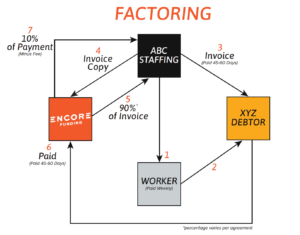
How Payroll Funding Works
The process is straightforward:
- You place workers and generate invoices
- You submit those invoices to your funding partner
- You receive an advance, typically 80–90% of the invoice value
- Your customer pays according to terms
- The remaining balance is released to you, less fees
Once the facility is in place, this cycle repeats continuously, creating a predictable source of working capital tied directly to your revenue.
I’ve heard payroll factoring myths and misconceptions from staffing entrepreneurs firsthand. Perhaps you’ve heard some of these as well. My team sets the record straight here!
Why Staffing Companies Use Payroll Funding
Staffing businesses operate with a built-in cash flow mismatch. Payroll is immediate and non-negotiable. Client payments are delayed and often inconsistent.
This creates real pressure as you grow.
First, growth becomes constrained. Every new placement requires upfront cash, so your ability to scale is limited by your available capital, not your demand.
Second, payroll risk increases. Missing payroll is not an option, and even short-term gaps can damage relationships with both employees and clients.
Third, working capital becomes strained. As revenue increases, so does the gap between when you pay employees and when you get paid, which can actually make growth more stressful rather than less.
Payroll funding addresses these issues by aligning your cash flow with your activity, not your payment timelines.
Key Advantages of Payroll Funding
One of the primary advantages is speed. Once your facility is in place, funding is typically available within 24 hours, allowing you to meet payroll without disruption.
It also scales with your business. As your invoice volume increases, your available capital increases alongside it, without the need to renegotiate limits or reapply for financing.
Payroll funding is also more accessible than traditional bank financing. Because it is based on the strength of your receivables rather than your balance sheet alone, it can be a viable option for newer or rapidly growing companies.
What Payroll Funding Does Not Solve
Payroll funding is a powerful tool, but it is not a cure-all.
It does not improve your underlying margins. The cost of funding reduces your net profitability, so it needs to be factored into your pricing and operating model.
It does not fix operational inefficiencies. Issues like poor billing processes, weak collections, or inaccurate job costing will still exist and can become more visible as you scale.
It also does not replace financial discipline. If used improperly, it can become a permanent dependency rather than a strategic growth tool.
Is Payroll Funding Right for Your Business?
Payroll funding is typically a strong fit for staffing companies that are growing quickly, working with clients on extended payment terms, or experiencing consistent cash flow gaps tied to payroll timing.
It is especially valuable for firms that want to take on new business without being constrained by working capital.
However, it may not be the right solution if your margins are already tight, your receivables are inconsistent, or you are relying on it to cover underlying operational issues rather than support growth.
Final Thought
For staffing companies, the challenge is not just winning new business, it is having the capital to support that business.
Payroll funding works best when it is used intentionally, as a tool to support controlled, profitable growth rather than as a reaction to ongoing cash flow pressure.
When structured properly, it allows you to focus less on timing gaps and more on building your business.
When you’re ready to level up your staffing business, Encore Funding is here to support you with expert advice and fast, secure funding. Apply here to start the conversation.