info@encore-funding.com
 216-998-9900

Bank Loans vs. Payroll Funding for Staffing Companies

If your staffing firm needs boosted cash flow, you’ve probably considered a bank loan. The rates and terms may seem enticing on the surface, but many staffing entrepreneurs soon find out that banks have limited funding capacity and inflexible support. Not to mention a lack of staffing industry expertise.
Payroll funding for staffing companies offers a faster, easier way to access the cash you need to grow. It helps you eliminate the long approval process, requirements, and red tape that are baked into the bank loan process.
Read on to learn more about bank loans vs. payroll funding and how a true funding partner helps you achieve your growth goals, not just provide cash support.
Payroll Funding vs. Bank Loans: What’s the Big Difference?
If you’re unfamiliar with payroll funding for staffing companies, let’s cover some basics. Payroll funding helps staffing entrepreneurs obtain capital quickly and with the flexibility not offered by traditional bank financing.
It also doesn’t involve interest rates, which is one of the biggest differences between payroll funding and a bank loan. Payroll funding fees may be structured several ways:
- Flat fee charged on the invoice amount
- Daily rate that starts after a particular number of days the invoice has remained unpaid, or an interval rate
- Interval rate is a specific percentage added after a certain number of days the invoice remains unpaid.
Funders can charge a combination of the fees mentioned; your fee structure normally depends on how risk-averse you are. We’ll cover fees and interest rates in more depth later.
Despite more types of fees, payroll funding is much more flexible than a bank loan. A bank loan is typically for a specific amount of capital, limited by the borrower’s financial strength. Funders like Encore Funding, on the other hand, offer flexibility because our credit decisions aren’t based on your financial situation; they’re based on who pays the invoices–your customers.
At Encore Funding, we know your needs can change from year to year or even month to month. That’s why we tailor our services to fit your needs. You won’t find that at a bank! This flexibility allows you to grow your firm without running into cash flow issues.
As in all commercial financing requests, some paperwork is involved. However, payroll funding doesn’t require extensive, repeated credit checks or extremely lengthy paperwork, making it a faster, simpler option for short-term capital needs.
Eligibility Requirements
Most banks require some form of security to approve a loan, which can prohibit staffing entrepreneurs from securing traditional bank loans because they lack hard assets. These can be property or other forms of personal or business assets, but a staffing company’s assets are its accounts receivable, which aren’t hard assets.
This is where payroll funding comes in. Because your funding partner is the one who ultimately receives payments from your clients, you don’t need additional forms of security when applying. Payroll funding for staffing companies is easier to qualify for than standard lines of credit or SBA loans from banks. To qualify for payroll funding, staffing companies should have an established history of timely employee payment and a finance plan with identifiable sources of capital.
Compare this to bank loan requirements. For a staffing firm to receive a bank loan they will need to have several years in business documented, a significant amount of quickly-turning accounts receivable plus the principal will need sufficient personal net worth.
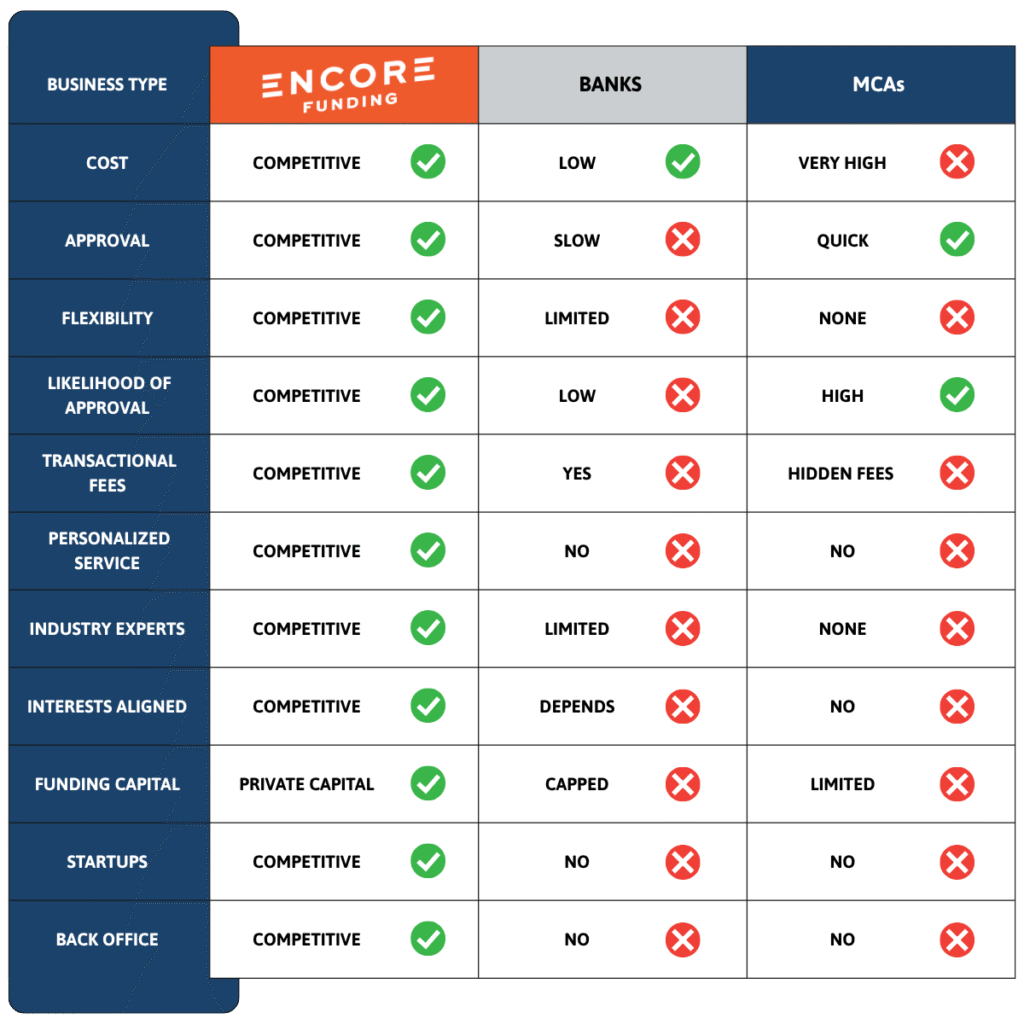
When it comes to the staffing industry, time is money and you can’t afford to waste either resource. Traditional bank loans typically take a few weeks (or months!) to apply for and receive funding from, depending on the size of the loan and the number of documents required. If you don’t have weeks to wait for cash, payroll funding is the better option.
At Encore Funding, our application is quick, easy and you’ll hear back from a real person on our team in just one business day.
Terms & Conditions
Payroll funding typically has shorter terms than traditional bank loans, meaning you receive funding faster. At Encore Funding, our terms are typically twenty-four months, but shorter terms can be negotiated. Because you mainly receive funding for the invoices you submit, you receive funds according to that amount, not in one lump sum.
Bank loans, on the other hand, include rigid repayment options and you must make large, fixed payments over the course of a set period.
Fees vs. Interest Rates
As mentioned above, payroll funding involves a fee, not an interest rate, which is why the cost of payroll funding can vary – we cover this topic more in-depth here. However, any fees associated with setting up a payroll funding facility are outweighed by the flexibility and support offered by payroll funding companies such as Encore. This isn’t the case with traditional bank financing!
So, how much does payroll funding actually cost? Payroll funding companies generally charge a fee of 1% to 3% of the billed amount. This fee is higher than bank rates but gives you the security of knowing that funds will always be there to cover your staffing firm’s cash flow needs.
Bank loan rates are typically offered at prime plus, but the loans are for a fixed amount with several covenant requirements. If business is good, this type of loan does not usually allow for further funds to cover additional cash flow. This inflexibility may hurt your cash flow in the long run.
In addition to your interest rate, a bank may charge you a hefty origination fee and other types of fees. This raises the barrier of entry for many staffing firms that don’t have enough liquid capital.
Bank loan interest rates are typically calculated using the prime lending rate plus an additional percentage, depending on your credit score and financial history. This rate can be either fixed or variable, with variable rates often being more expensive in the long run because of changes in market conditions. On the other hand, payroll funding typically has fixed discount fees, making it easier to budget and plan for future expenses.
Whether you access funding through a private partner like Encore or a bank, be sure to do thorough research on fees and interest rates before making a final decision.
Length of Funding
Another key difference between payroll funding for staffing firms and bank loans is how long the funding lasts. With bank loans, staffing entrepreneurs have a fixed amount of money to use for their firm. Once the money from the loan is used, you have to apply for an extension or another loan if you still need funding.
Payroll funding, on the other hand, doesn’t have a definite end date. You can continue with payroll funding as long as you submit them to be covered, are satisfied with your funding provider, and have clients who reliably pay their invoices.
Which Offers Better Support Services?
Bank loans seem cut-and-dried and impersonal, because they are. At Encore Funding, staffing entrepreneurs can grow faster than bank-funded peers with access to experts and services like private capital funding options, strategic consulting and back-office support.
Our strong balance sheet, creative solutions, and value for the services we offer help staffing entrepreneurs achieve their vision of success. We’ve also been staffing industry experts for over 30 years, funding over $30 billion
By working with a privately funded payroll funding partner like Encore Funding, you have access to tailored financial solutions and strategic consulting services not offered through a bank. This gives you an edge over other staffing firms that may not have a strong support system.
Growth Through Payroll Funding for Staffing Companies
Whether you pursue payroll funding, a bank loan, or a combination of both, we encourage you to thoroughly research the funding providers and terms. If you’ve been firmly established in the business for decades, your sales are predictable, and your financials are in good shape, then a bank loan may be for you. But, if you’re newer to the industry and hungry for growth, payroll funding is the flexible option that supports your business rather than restricts it.
At a bank, you’re just a number. With Encore Funding, we’re partners! You gain access to funding experts with over 30 years of experience and all their knowledge at no additional cost. We are entrepreneurs serving entrepreneurs and our goal is to help you achieve your version of success. Fill out our short application here and an Encore team member will be in touch within one business day.